Saturday, 15 February 2014

Configuration of Shipping Point Determination in Delivery Process

In SAP SD process, shipping point plays key role in delivery process. In this blog I have tried to define all possible configuration with respect to Shipping point and its determination. Use the following steps to define to define and configure Shipping Point and determination in SAP SD.

Step 1: Define Shipping Conditions


Menu Path: SAP Customizing Implementation Guide --> Logistics Execution --> Shipping --> Basic Shipping Functions --> Shipping Point and Goods Receiving Point Determination --> Define Shipping Conditions

The shipping conditions are filled in the customer master record in the shipping screen and in the sales document type. Such settings are then come into the sales document while order creation and they are used to determine the shipping point in it. The shipping conditions can be manually changed in the sales order, or they can be set default to a particular sales document type. They can be set default to a particular sales document type, then system will ignore the setting on the customer master record.

Continue with copying a shipping condition and rename to define your requirements, using the prefix Z. The shipping condition name is a two-character alphanumeric value, as seen in screen below.


shipping point in sap sd delivery process

Now you can define the shipping condition with given path,

Menu Path: SAP Customizing Implementation Guide --> Logistics Execution --> Shipping --> Basic Shipping Functions --> Shipping Point and Goods Receiving Point Determination --> Define Shipping Conditions by Sales Document Type

Sunday, 5 January 2014

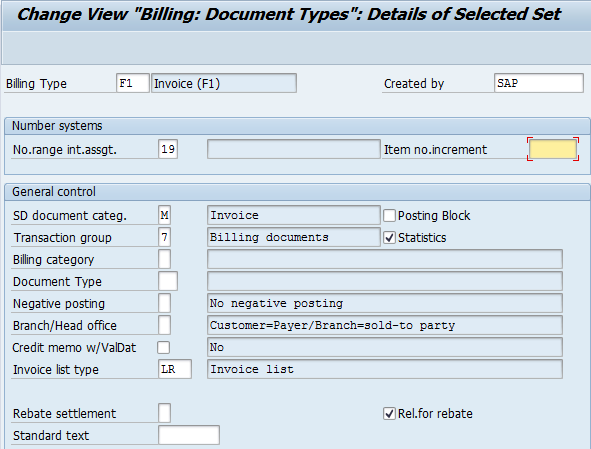
How to Define Billing Document Types in SAP SD


The billing document is similar to the delivery document in that it has a header and item level, but no schedule line level, as in the sales documents. Thus one must configure the header document type and the relevant item categories.

To define the billing document type, use the following menu path.

SAP Customizing Implementation Guide --> Sales and Distribution --> Billing--> Billing Documents --> Define Billing Types --> Define Billing Types

Change or Create Billing Document Types in SAP SD

Monday, 2 December 2013

Basics of Document Data Flow and Copying Control in SAP SD Process

Data flow and copying control are basic but most important functionality in SAP SD process. Copy Control functionality controls which data is copied from the source document to the following document. For example, you can define a fresh sales order type and utilize the recently created sales order type for a latest delivery order. For this intention, you can define a new copy control for data flow between these two sales documents. If you don’t maintain the copy control from an origin document type to a end document type and try to create the target document copying from the source, the system will prompt you with an error.

Data Flow:

You can create sales document with reference to a preceding document from both: 
  1. Initial screen and 
  2. During Document Processing
Create document with preceding document in SAP SD

Tuesday, 12 November 2013

Pricing Configuration in SAP SD

Pricing plays very vital role in SAP SD process, this is why it is very important for SAP SD aspirants to know pricing concept in depth for real time practice and certification exam perspective. In this blog I will explain you on how to configure the pricing in SAP SD. You can expect many more concepts related to pricing in upcoming blogs. 

You can follow my SAP SD Certification Guide to achieve maximum success in your SAP SD certification. Apart from this, I have designed 600+ topic wise question bank with accurate answers and related screenshot where you can not miss any questions for your SAP SD certification preparation.

Pricing configuration in SAP SD:


To create any pricing condition type, following steps you need to remember in short
  1. Define condition table
  2. Define condition type
  3. Define access sequence
  4. Assign access sequence to condition type
  5. Define and assign pricing procedure
    1. Maintain pricing procedure
    2. Define customer pricing procedure
    3. Define pricing procedure determination
1) Define Condition Table:

Navigate to given path
IMG --> Sales and Distribution --> Basic function --> Pricing --> Pricing Control --> Define Condition Tables --> Create Condition Table

Provide table no as 273(you can give any) and press enter


Create condition record in pricing configuration in SAP SD
www.hypersmash.com